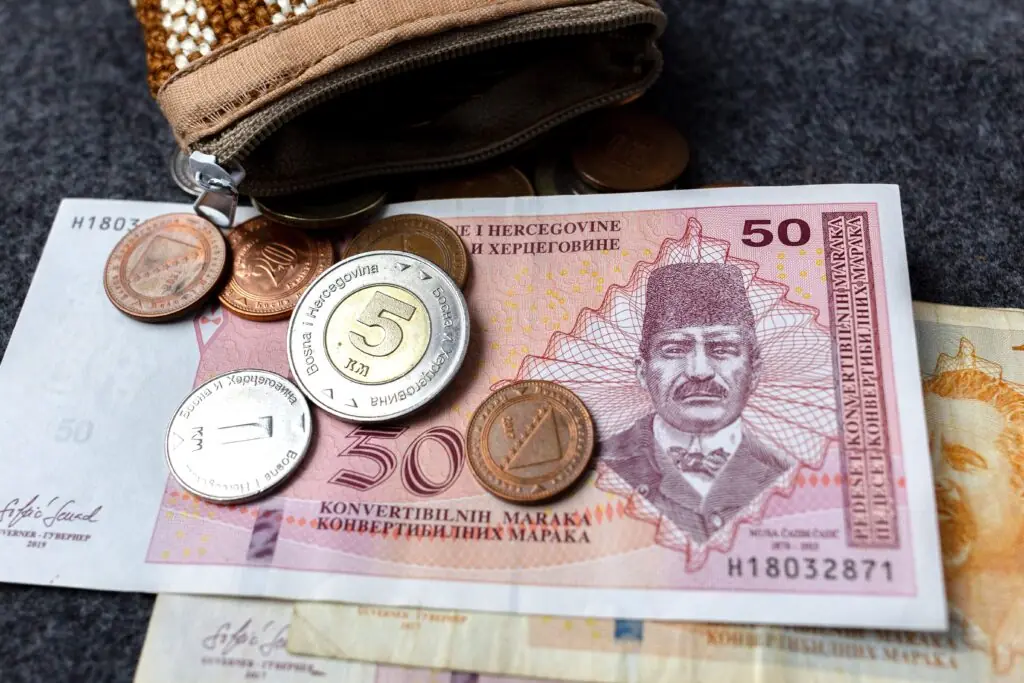

Bosnia and Herzegovina currency tips for tourists
The official currency of Bosnia and Herzegovina is the convertible mark, identified by the code BAM and usually shown with the symbol KM.
Although euros may be accepted by some tourist businesses, you should expect to pay in convertible marks, particularly in local shops, restaurants, markets and smaller towns.
Quick facts: Bosnia and Herzegovina convertible mark (BAM)
| Code | BAM |
| Symbol | KM |
| Subunit | 1 convertible mark equals 100 fening |
| Common banknotes | KM10, KM20, KM50, KM100 and KM200 |
| Common coins | 5, 10, 20 and 50 fening, plus KM1, KM2 and KM5 coins |
| Where used | Bosnia and Herzegovina |
| Euro relationship | The official fixed rate is €1 = KM1.95583 |
| Cash vs card | Cards are more commonly accepted in larger cities; carry BAM cash for smaller businesses, markets and rural areas |
| Simple tip | Keep smaller BAM notes available for taxis, cafés and market purchases |
What is the currency of Bosnia and Herzegovina?
The currency of Bosnia and Herzegovina is the Bosnia Herzegovina convertible mark, issued by the Central Bank.
You might also see it written as the Bosnia and Herzegovina currency code BAM.
The word “mark” harks back to German history, since the BAM was originally pegged to the Deutsche Mark.
Today, it’s firmly linked to the euro, which keeps the value stable for both visitors and locals.
Can you buy Bosnian convertible marks in the UK?
Yes. Although most high-street banks don’t routinely stock BAM, specialist providers such as Manor FX allow you to order Bosnian convertible marks online for UK home delivery or collection near Heathrow.
Does Bosnia use the euro?
Bosnia and Herzegovina does not use the euro as its official currency. It uses the Bosnia and Herzegovina convertible mark, abbreviated BAM and commonly shown locally as KM.
The convertible mark has a fixed exchange rate of EUR 1 = BAM 1.95583.
Some tourist-facing businesses may accept euros, but this is not guaranteed and change may be given in convertible marks. Use BAM for normal local purchases rather than relying on euros.

A quick history of the Bosnia Herzegovina convertible mark
Money tells a country’s story, and Bosnia’s is a fascinating one.
After the breakup of Yugoslavia in the 1990s, the Yugoslav dinar was eventually replaced.
In 1998, the new Bosnia Herzegovina convertible mark was officially introduced as the national tender.
The BAM’s link to the euro ensures a fixed exchange rate, which was designed to prevent the kind of wild inflation the region had experienced under the Yugoslav dinar.
Today, the mark’s value remains stable, making it one of the more reliable Balkan currencies.
Bosnia Herzegovina convertible mark and its denominations
The Bosnian convertible mark is the everyday money you’ll use in Bosnia and Herzegovina.
One convertible mark is divided into 100 fening, and you’ll encounter both coins and banknotes during your trip.
Coins in Bosnia and Herzegovina
Small change is essential in Bosnia, especially when paying in cafes, hopping into taxis, or shopping in local markets.
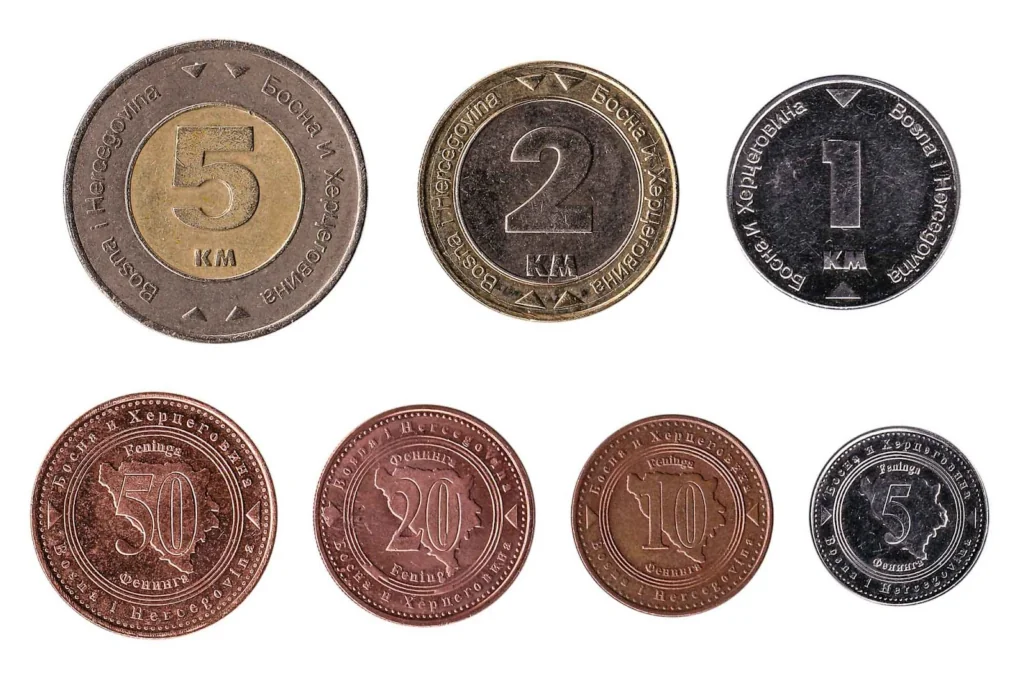
You’ll find coins in 5, 10, 20 and 50 fening, plus 1 and 2 marks.
These are minted in sturdy alloys like copper, nickel and copper plated steel, while some higher values even use nickel brass.
Look closely and you might notice textured reverse edges or a two-tone effect, featuring an outer ring and an inner ring.
On the reverse side, many designs feature the BH flag, local landmarks or even a map recalling the days of Yugoslavia.
Bosnia currency: banknotes you’ll use daily
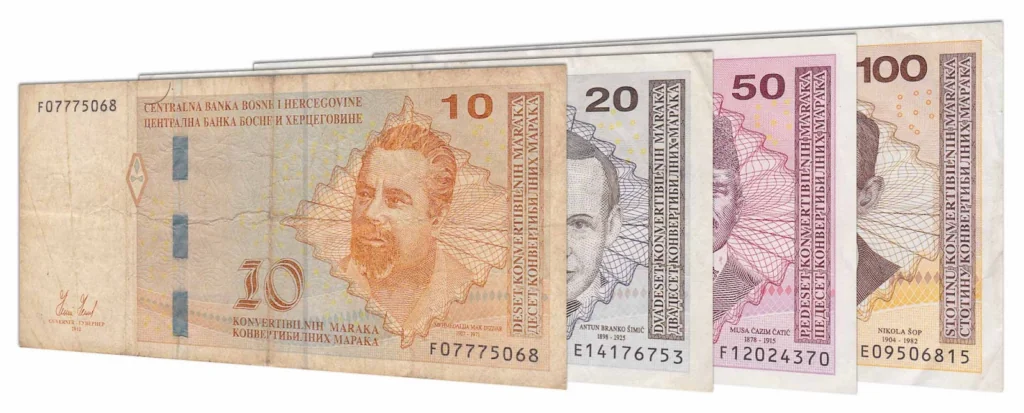
Paper Bosnia currency comes in denominations of 10, 20, 50, 100 and 200 marks.
Each banknote is beautifully decorated with images of Bosnian poets, artists, and thinkers, with the words printed in both Latin and Cyrillic script to reflect the country’s official languages.
These notes are not only legal tender but also small works of art, celebrating the spirit of Bosnia and Herzegovina.
If you’re a collector of world coins and notes, keep an eye out for unusual editions.
Some early first series notes featured a quirky printing mistake, making them highly prized as limited collector’s items.

The value of the BAM currency against the euro
One convertible mark equals exactly 0.51129 euros, so two marks make up just over one euro.
This fixed peg means the Herzegovina convertible mark has maintained a very consistent value since its introduction.
For travellers, that’s excellent news – you’ll know roughly what your money is worth in Bosnia and Herzegovina before you even arrive.
Bosnia and Herzegovina: exchange tips for travellers
Heading to Bosnia and Herzegovina soon?
Then you’ll want to get your currency sorted out before your plane even leaves the UK.
Although you might find places to change Bosnia Herzegovina currency once you arrive, you’ll usually get the best rates by ordering online.
At Manor FX, you can check out our rates any time and have your cash delivered straight to your door – a stress-free way to prepare for your destination.
Should I buy Bosnian convertible marks before travelling?
Arriving with some BAM means you can pay for transport, food and other immediate expenses without first finding a working ATM or exchange office.
Manor FX allows UK travellers to order Bosnian convertible marks online for home delivery or collection near Heathrow.
Where to exchange Bosnia Herzegovina currency
Looking for the currency for Bosnia and Herzegovina before your trip? Here are the main options travellers consider:
- Airports – Convenient, but usually the worst place for exchange; expect higher margins.
- Banks – Reliable but often slow, with queues and limited opening times.
- ATMs in Bosnia – Handy in cities like Sarajevo, but fees and withdrawal limits can make them expensive.
Here’s the thing: the Bosnia Herzegovina currency isn’t widely stocked in the UK.
Many high street providers simply don’t carry it. That’s why it pays to plan ahead.
With Manor FX, you can:
- Order BAM currency online with no minimum order
- Enjoy free delivery on orders over £750
- Get the BAM exchange rate you see – no hidden extras or sneaky fees
- Choose home delivery or click and collect for total flexibility
That way, you’ll arrive in Bosnia and Herzegovina with cash in your pocket, ready to pay in Bosnia Herzegovina convertible mark from the moment you land.
Understanding BAM currency exchange rate
Wondering how far your pounds will stretch?
The Bosnia currency to GBP calculation is straightforward once you know the fixed peg to the euro.
Since one BAM equals roughly half a euro, you can estimate the conversion by halving the euro exchange rate.
For example, if £1 = 1.15 eur, then £1 = about 2.25 marks.
To make things even easier, keep an eye on live BAM exchange rates before you travel.
You can also compare with other countries in the region where the Bosnian currency holds up well against the British pound.
How to pay in Bosnia
In Bosnia, you’ll use cash a lot.
While card payments are widely accepted in bigger cities, smaller shops, family-run cafes and local markets often prefer the Bosnian convertible mark in hand.
Even some taxis will expect you to pay in marks.
ATMs are common in larger towns, but withdrawal fees vary. Always check before taking out money, and keep some smaller bills for everyday expenses.
Remember: only the BAM is legal tender, so even if you carry the British pound or euro, you’ll still need to use the local currency in Bosnia Herzegovina for daily spending.
Travelling to Herzegovina and beyond
If your Bosnia Herzegovina adventure takes you south into Herzegovina, don’t worry – the same Herzegovina currency applies.
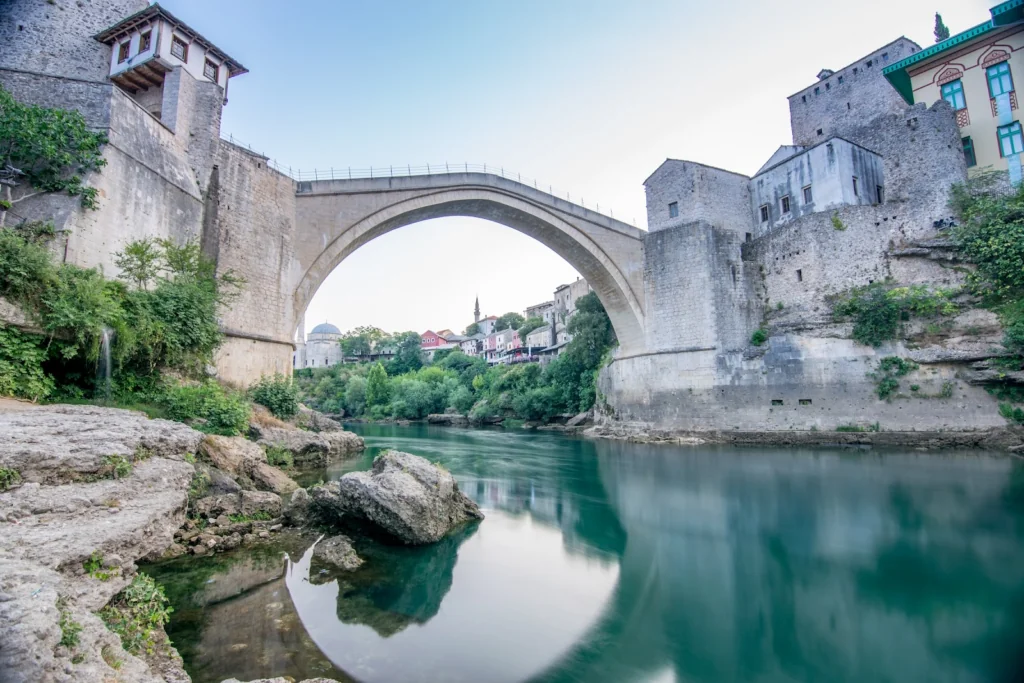
From the historic streets of Mostar city to a hillside town in the countryside, the Bosnian convertible mark is used everywhere.
If you’re planning to cross into neighbouring countries like Croatia or Montenegro, remember you’ll need different money at the border.
Double-check current visa rules too, as visa requirements vary depending on your nationality.
Converting leftover currency after your trip
Don’t let those marks gather dust in a drawer.
You can bring your BAM currency back home and exchange it for GBP or spend it at Manor FX through our buy-back service.
It’s an easy way to get money back from your holiday without hassle.

Fun facts about Bosnian currency
Travelling with the Bosnian convertible mark isn’t just practical – it’s a little lesson in history and culture too.
Here are a few quirky tidbits:
- Some banknotes from the early first series had a printing *mistake, making them highly collectable.
- The convertible mark initially replaced the Yugoslav dinar, a reminder of Yugoslavia’s turbulent past.
- Certain coins feature the Bosnia Herzegovina flag and regional designs, celebrating Bosnian identity.
- A few commemorative issues were printed in limited numbers, which collectors worldwide (world numismatists) treasure.
- On some marks, the designs include a map or national symbols, showing pride in Bosnia and Herzegovina.
It’s a reminder that money isn’t just for spending – it also tells stories about Bosnia and its rich cultural heritage.
For the story behind the currency, read the convertible mark’s history.
How to get your currency with Manor FX
Sorting your travel cash shouldn’t be a chore. Here’s how easy it is to prepare for your trip with Manor FX:
- Browse online – Head to our Bosnia & Herzegovina currency page to see live BAM exchange rates.
- Check and compare – You can quickly compare with the British pound or other countries’ currencies to be confident you’re getting the best exchange rates.
- Place your order – Choose the amount of BAM currency you’ll need for your city break or rural town getaway.
- Delivery to your door – We send your cash safely and securely with a trusted service, so you’re ready to go. Or you can click and collect if you prefer.
When you arrive in Bosnia, you can dive straight into the bustle of local markets, hop into taxis, or enjoy a coffee in a cosy Bosnian café without worrying whether your money will be accepted.
Takeaways
Travelling through Bosnia and Herzegovina is an unforgettable experience – from the cobbled lanes of Sarajevo to the dramatic landscapes of Herzegovina.
Knowing how the currency of Bosnia and Herzegovina works will make your journey smoother, cheaper, and more enjoyable.
Get your currency for Bosnia sorted before you travel, enjoy using colourful banknotes and practical coins, and make the most of your trip by securing the best rates when you exchange.
And when your adventure is over?
Don’t forget to turn your leftover currency back into GBP with our easy service.
It’s the smart way to make your travel money go further.
Safe travels – and enjoy every mark you spend in this beautiful Balkan destination!
FAQ
Card acceptance is increasing in cities and tourist areas, particularly at hotels, larger shops and restaurants. However, Bosnia and Herzegovina remains substantially cash-based, and smaller businesses, cafés, markets, taxis and rural locations may require convertible marks. Carry both a payment card and enough BAM cash for places where cards are not accepted or the terminal is unavailable.
ATMs are available in major towns and cities but can be limited in rural areas. Use a machine attached to or inside a bank where possible. Review the ATM fee and your card provider’s charges before confirming a withdrawal. If the machine offers to convert the withdrawal into pounds, choosing to be charged in BAM normally lets your own card provider apply the exchange rate instead.
A mixture of smaller notes and coins is useful for taxis, cafés, markets and low-value purchases. Avoid relying only on KM100 or KM200 notes, because small businesses may not have enough change.