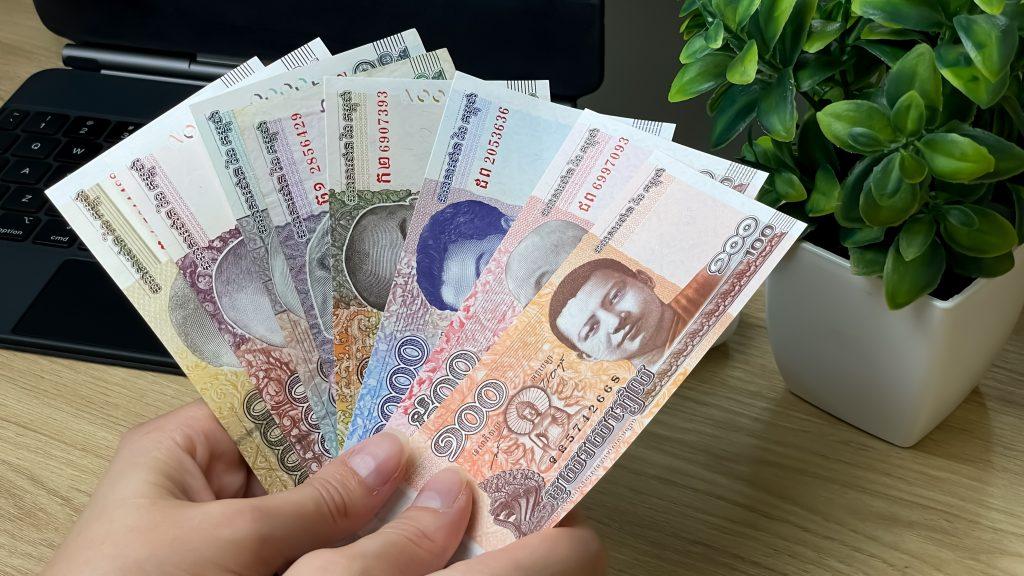

Cambodia currency: what to know before you go
The currency in Cambodia is the Cambodian riel (KHR), but you will often come across US dollars as well, especially in tourist areas.
For UK travellers, the simplest approach is to understand how the two work side by side: riel is the national currency, while dollars still appear in some hotels, restaurants and travel-facing businesses.
This guide covers the key basics, including the currency code, notes and coins, cash versus card use, and how to sort your Cambodia travel money before you go.
Quick facts: Cambodian riel (KHR)
| Code | KHR |
| Symbol | ៛ |
| Also used | US dollars are still commonly used in parts of Cambodia |
| Subunit | Cent (100 cents = 1 dollar) |
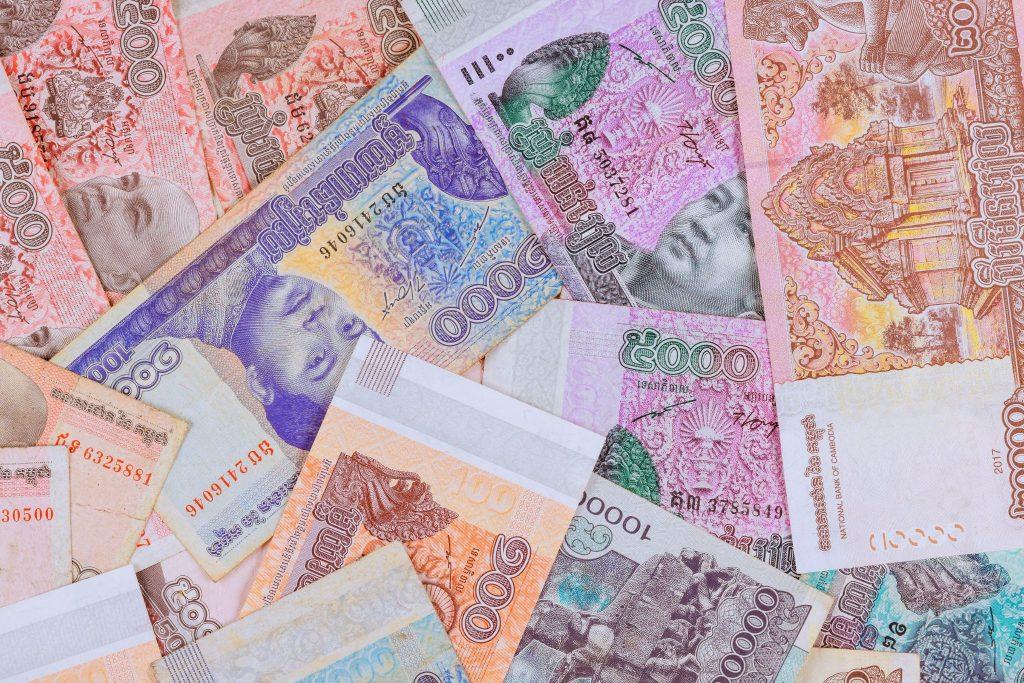
| Common banknotes | KHR 100, 500, 1,000, 2,000, 5,000, 10,000, 20,000, 50,000, 100,000 |
| Common coins | Coins exist but are rarely used in everyday transactions |
| Where used | Cambodia |
| Cash vs card | Cards are accepted in many larger businesses, but cash is still useful, especially outside major tourist areas |
| Simple tip | Carry some smaller riel notes for day-to-day spending and change, even if you also use dollars or cards. |
What is the main currency in Cambodia?
The main local currency is the Cambodian riel, sometimes written as cambodian riel currency or Cambodian riel KHR.
KHR is the currency code you will see on a currency converter, on exchange boards, and when checking a Cambodia currency to GBP comparison.
Does Cambodia use riel or USD?
It uses both. The Cambodian riel is the national currency of Cambodia, but US dollars are still widely used and widely accepted, especially in tourist areas, larger hotels, some restaurants, and many travel-facing businesses.
In plenty of places, you may pay in dollars and get your change back in riel.
That mix is one of the first things travellers notice about money in Cambodia.
What currency is best to take to Cambodia?
For most people, the best currency for Cambodia is a practical mix.
Take some Cambodian riel for everyday spending, smaller purchases, and local transactions, and understand that US dollars still appear in parts of the visitor economy.
For simple day-to-day use, though, the best currency to use in Cambodia is increasingly the local currency, especially for small purchases and exact change.

Cambodian riel notes, coins and what to watch for
The Cambodian riel comes mainly as banknotes.
The National Bank of Cambodia says coins are rarely used, so in practice, you are far more likely to handle Cambodian riel banknotes than Cambodian riel coins.
Common notes in circulation include KHR 100, 500, 1,000, 2,000, 5,000, 10,000, 20,000, 50,000 and 100,000.
If you are handling cash, keep an eye on the condition of each note, because very damaged or torn notes can sometimes be awkward to use.
How people actually pay in Cambodia
In Phnom Penh and Siem Reap, digital payment options, cards and mixed-currency pricing are more common.
In smaller places, markets and some independent restaurants and businesses still rely on cash for much of the work.
That means it helps to carry some smaller riel notes so you are not constantly waiting for change or trying to break a larger note for a small purchase.
When cards help and when cash still matters
Cards can be useful, but cash still matters.
The UK government says cards are accepted in larger businesses in Cambodia, but it is wise to have another way to access money if your card does not work.
That matters even more in rural areas, where card acceptance can be more limited, and ATMs may be harder to find.
A sensible holiday plan is to carry cash for everyday use and keep cards as a backup.

What to know about ATMs in Cambodia
If you plan to withdraw money, check your bank first for overseas fees, cash withdrawals charges, and any small fees added by local ATMs.
It is also worth checking whether your account is set up for ATMs abroad, whether your phone number is linked for security checks (as chip and pin isn’t so common), and whether your Visa card will work where you are going.
When in doubt, do not rely on one card alone.
Using a currency converter before you go
A currency converter is useful before your trip, especially if you want to keep an eye on the latest KHR and GBP rates.
If you’re travelling from the UK, it can help you get a rough sense of what your pounds are worth before you buy. Just remember that a converter is only a guide.
It can help you double-check the market before you exchange money, but it will not always match the exact rate a provider offers.
Cambodia currency rate basics
The Cambodia currency exchange rate you see online is not always the rate you will get as a customer.
The National Bank of Cambodia publishes official exchange data, including a daily KHR to USD reference and cross-rates for currencies such as GBP and EUR.
That makes it a good place to double-check the broader market before you buy.
If you are looking at the Cambodian riel exchange rate, the key thing is to compare the total value you receive after any fees, delivery costs or markups.
Mid-market exchange rate versus customer rate
The mid-market exchange rate is a useful benchmark, but it is not usually the exact rate a traveller gets when buying holiday currency.
Real-world currency exchange includes margin, handling costs and sometimes extra fees.
So the best currency to take to Cambodia is not just about the headline exchange rate.
It is also about the total value, how easy the purchasing process is, and whether the provider feels secure and that the process is transparent.
Are travellers’ cheques worth bringing?
Probably not. Travellers’ cheques now feel more like a museum piece than a smart modern travel tool.
In much of the world, they are far less practical than they used to be, and in Cambodia, they are not the first thing you would choose for everyday spending.
For most tourists, using a mix of cash, cards, and pre-bought currency is far easier than trying to manage travellers’ cheques on the move.
Phnom Penh, Siem Reap and rural areas
Payment habits can vary by place. In Phnom Penh and Siem Reap, visitor-facing hotels, shops and restaurants are more likely to have modern payment options.
In more remote parts of the country, cash becomes more important. So if your holiday is moving beyond the obvious tourist circuit, it is advisable to have enough Cambodian riel on hand for the quieter stretches too.
Where to buy Cambodian riels in the UK
| Option | What to expect |
| Specialist bureau (online) | The simplest option for less common currencies: compare rates and order ahead. Get the best rates and swift home delivery with Manor FX. |
| High street banks | Some currencies may need ordering in advance; availability can vary by branch. |
| Post Office | Stocks a range of travel money, but less common currencies may be limited or unavailable. |
| Airport exchange | Convenient, but higher costs; stock of rarer currencies can be unpredictable. |
Buy your riels now

How to get your Cambodian currency with Manor FX
Getting your currency for Cambodia sorted before you travel is usually the low-stress option.
With Manor FX, the idea is simple.
Choose how much Cambodian riel you want, review the KHR exchange rate, check the full cost, then decide whether you want delivery or collection.
It is a straightforward way to plan ahead, save last-minute hassle, and protect your holiday budget and ensure you’ve got more money in your wallet before you even head to the airport.
A nice bonus is that you can sort other currencies at the same time if Cambodia is only one stop on a bigger Asia trip.
That is a lot easier than scrambling to find a currency exchange after arrival.
Also, don’t worry if you get back to the UK with leftover travel money.
We’ll take care of your Cambodian riel to British pounds conversion. We have the best HR to GBP exchange rates.
A simple rule for Cambodia spending
Here is the short version. Keep some Cambodian riel with you; expect US dollars to appear in some settings; use a currency converter to double-check the market; and do not assume every provider offering Cambodia currency exchange is giving you the same deal.
If you plan ahead, carry a sensible mix, and keep an eye on fees, Cambodia is a very easy place to handle once you know the basics.