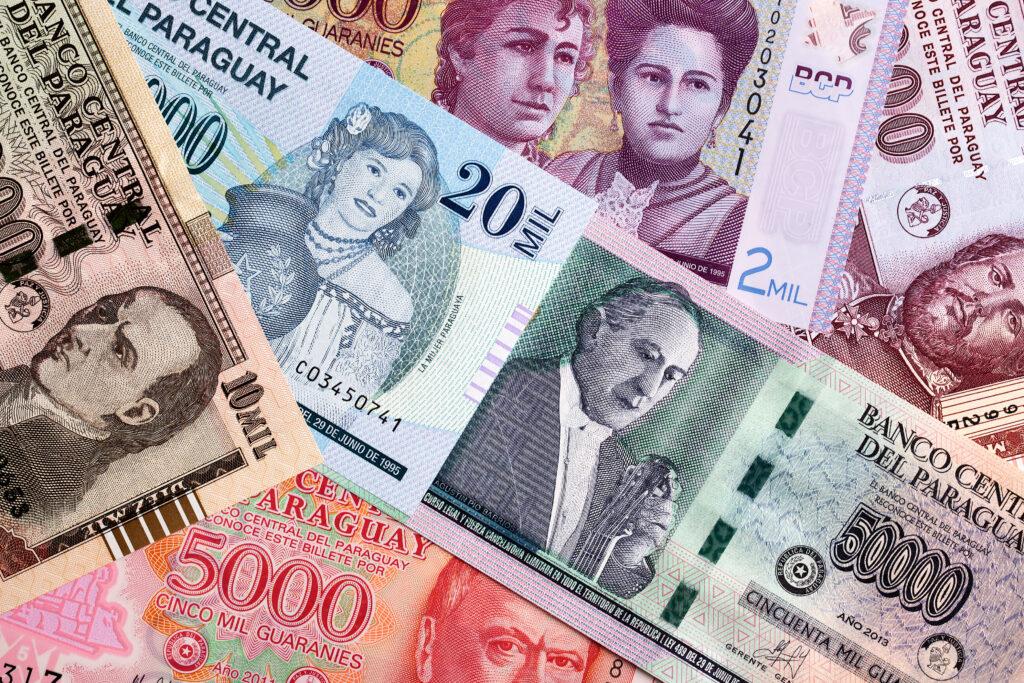

Paraguay currency: what to know before you go
Paraguay uses the Paraguayan guaraní (PYG), and it’s a cash-first destination once you’re outside the biggest city centres.
Cards work in larger hotels, supermarkets, and chain restaurants, but you’ll want guaraní banknotes for taxis, markets, buses, tips, and smaller shops.
This guide covers the essentials fast: the currency name, code and symbol, what notes you’ll actually use, how to avoid sneaky exchange mark-ups, and the simplest way to sort your travel cash before you fly.
Quick facts: Paraguayan guaraní (PYG)
| Code | PYG |
| Symbol | ₲ (sometimes written “Gs.”) |
| Subunit | 100 céntimos (not used in everyday spending) |
| Common banknotes | ₲2,000, ₲5,000, ₲10,000, ₲20,000, ₲50,000, ₲100,000 |
| Common coins | ₲50, ₲100, ₲500, ₲1,000 |
| Where used | Republic of Paraguay |
| Cash or card? | Cash is common for day-to-day; cards mainly in bigger-city businesses |
| Tourist tip | If a card terminal/ATM offers to charge you in GBP, choose PYG to avoid extra fees (dynamic currency conversion) |
What is the currency of Paraguay?
The currency of Paraguay is the Paraguayan guaraní.
It is the official currency you will see everywhere, from buses to bakeries.
Official currency of Paraguay basics and a quick bit of history
The guaraní is the official currency of Paraguay. It is technically divided into 100 céntimos, but céntimos are not used in everyday life because prices are far higher now.
If you see older mentions of the peso, that is historical.
The guaraní replaced the peso fuerte, with ₲1 equivalent to 100 pesos fuertes at the time of the changeover.
The law creating the guaraní was passed on 5 October 1943, and guaraníes were first issued in 1944.
More recently, in November 2009, the central bank launched the first ₲2,000 polymer notes, and newer designs have added enhanced security features over time.
You may also see “nuevo guaraní” mentioned online. A revaluation plan was proposed in 2011, but it is currently suspended.
The PYG code and ₲ sign
The Paraguay currency code is PYG (used by banks and currency converter tools).
You will also see the ₲ sign, or “Gs,” in some places.
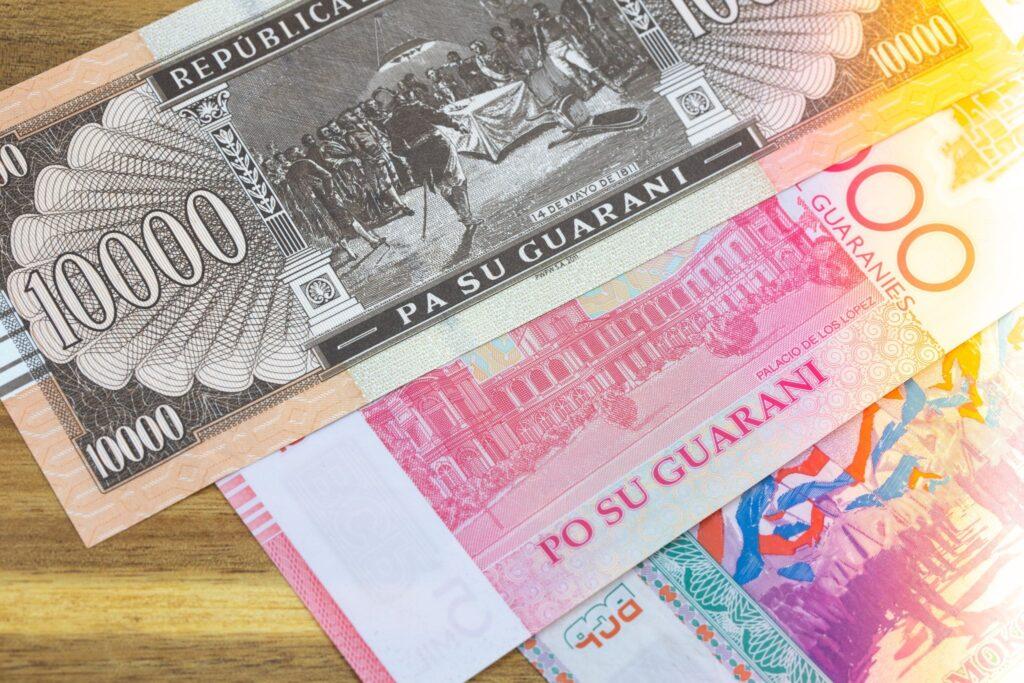
Notes and coins: Paraguayan guarani denominations you will actually use
Most travellers handle banknotes far more than coins, because the values are large.
Common notes include 2,000, 5,000, 10,000, 20,000, 50,000 and 100,000 guaraníes, so do not be surprised if a small purchase is paid with what looks like a big number.
In modern circulation, coins commonly include 50, 100, 500, and 1,000 guaraníes.
Quick tip for savings: keep a small mix of coins and lower notes set aside for taxis and tips, so you are not constantly breaking big banknotes and triggering extra fees.
Currency exchange rates: why they move
Your Paraguay currency exchange rate (and the general exchange rate) changes constantly, so any Paraguay currency rate you see online is a snapshot.
As a rule, you will get the fairest deal when you avoid surprise mark-ups and keep an eye on fees and provider spreads.
If you are checking before buying, the headline rate may look different tomorrow, so please check again close to ordering.
If you like visuals, a GBP chart or rate tracker can help you spot when the rate is drifting.
Tip: if a machine or terminal offers to bill you in GBP instead of PYG, that “helpful” option can add extra fees through dynamic currency conversion – always choose the local currency.

Paraguay guarani currency: simple conversion tips
If you are planning a budget, search for Paraguay currency to gbp or Paraguay currency to pounds, then double-check the result with a second currency converter.
It is often easier to work backwards from your GBP budget and convert once, rather than converting every small purchase.
If you are converting British pounds to Paraguayan guarani, compare a couple of providers, look at the total cost, and focus on the final amount of pyg you will receive rather than only the headline Paraguayan currency rate – that’s how you save money.
Currency exchange in Paraguay: where to exchange money
You can exchange money at banks, hotels, and licensed exchange offices (often called “casas de cambio”).
If you are already in-country, exchange offices can be convenient, but rates and fees can vary, so it is wise to compare rates before you hand over cash.
A practical approach is to arrive with enough Paraguayan guaraní for your first few days, then top up later if needed. It keeps you out of “airport pricing” and avoids the panic purchase.

Can I use US dollars in Paraguay?
Sometimes, yes. In tourist-heavy areas or for bigger purchases, US dollar cash may be accepted, but it is not the smoothest option for everyday spending.
You may get a poor in-store rate, limited change, or extra fees baked into the price.
For normal travel days, the currency in Paraguay you actually want is still the Paraguayan guarani.
Is Paraguay a poor or rich country?
Paraguay is classed as an upper-middle-income economy by many global organisations, but the traveller experience varies widely by city, region, and what you are doing.
In practical terms, it can feel good value compared with some South American neighbours, yet you should still budget for transport, food, and activities, plus the usual travel extras.
If you are visiting multiple countries in the region, plan your cash needs so you do not incur repeated fees each time you exchange.

Central Bank of Paraguay
The Central Bank of Paraguay (the Banco Central del Paraguay) oversees the national currency system, including issuing banknotes and maintaining monetary stability.
For travellers, that matters because it links to trust and consistency: what is in circulation, what designs are current, and how financial institutions handle authentication and withdrawals.
Staying safe with cash
Modern notes include enhanced security features designed to deter counterfeits.
One notable change was the move to polymer banknotes in 2,000 guaraní notes, which are generally more durable in real-world handling.
Simple safety rules still beat detective work: keep your cash split, do not flash big stacks, and use official exchange points and reputable bank branches when possible.
Where to buy Paraguayan guaraní in the UK
| Option | What to expect |
| Specialist bureau (online) | The simplest option for less common currencies: compare rates and order ahead. Get the best rates and swift home delivery with Manor FX. |
| High street banks | Some currencies may need ordering in advance; availability can vary by branch. |
| Post Office | Stocks a range of travel money, but less common currencies may be limited or unavailable. |
| Airport exchange | Convenient, but higher costs; stock of rarer currencies can be unpredictable. |
Buy your guaraní now

How to get your currency with Manor FX
If you want currency for Paraguay ready before you go, Manor FX lets you order Paraguayan currency online in the UK.
- Pick your amount in British pounds
Choose how much you want to spend in gbp, or the amount of pyg you would like to receive.
- Lock in your GBP PYG rate
You will see the live pyg exchange rate today and any delivery fees before you place the order. This is the moment to check the total cost, not just the headline rate.
- Choose delivery or collection
Select secure home delivery, or collect near Heathrow if that suits your travel plans.
- Pay safely and get confirmation
Complete your details, pay by the available method (including bank transfer where applicable), and keep the confirmation for your records.
This approach is often cheaper and calmer than hunting around at the last minute, especially if you want to avoid airport mark-ups and rushed decisions.
Top tip: If you get back from Paraguay with leftover holiday money, don’t worry, we’ve got you covered. We offer excellent PYG to GBP exchange rates and will happily help you convert remaining travel funds back to GBP.
FAQs
Do Manor FX offer money transfers or international money transfers?
Manor FX focuses on travel cash and currency exchange. We do not provide money transfers, international money transfers, or services to send money abroad to bank accounts. If you need to send money or money transfers, you will want a specialist transfer provider or your bank.