

Brazil currency: what UK travellers need to know
The currency in Brazil is the Brazilian real (BRL). You’ll see prices shown with R$, and the plural is reais – so BRL (code), R$ (symbol), and reais (plural) all refer to the same currency.
For UK travellers, a simple approach works best: carry some cash for smaller purchases and taxis, and use your card in cities and larger businesses.
This guide covers the essentials: how to read prices, what notes and coins you’ll use, and how to avoid hidden fees when exchanging GBP to Brazilian reais.
Quick facts: Brazilian real (BRL)
| Currency name | Brazilian real (plural: reais) |
| Code | BRL |
| Symbol | R$ |
| Subunit | Centavo (100 centavos = 1 real) |
| Common banknotes | R$2, R$5, R$10, R$20, R$50, R$100, R$200 |
| Common coins | 5, 10, 25, 50 centavos; R$1 |
| Where used | Brazil |
| Cash vs card | Cards are widely accepted in cities; cash is useful for smaller purchases, tips, and local transport |
| Simple tip | Always choose BRL (local currency) if a terminal offers to charge you in GBP to avoid extra conversion fees |
What is Brazil’s currency called?
Brazil uses the Brazilian real. It’s the only currency officially accepted in Brazil as legal tender.
You’ll often see it written in three different ways, depending on the context: real is the name of the currency, reais is the plural, BRL is the currency code used in converters and rate tools, and R$ is the symbol you’ll see on menus, receipts, and price tags in Brazil.
So if you spot R$20 in a café or BRL on an exchange page, they are both referring to the same currency. Once you know that, reading prices in Brazil is much more straightforward.

When did Brazil switch to reais?
Brazil switched to the real in July 1994.
The new currency replaced the cruzeiro real, which had circulated for only about 10 months.
The Central Bank of Brazil says the present-day real replaced the cruzeiro real as part of a wider stabilisation effort after a long period of inflation and multiple currency changes.
That bit of history matters because it explains why the real remains such an important symbol in the Brazilian economy.
The current real was introduced to help stabilise prices, restore confidence, and give the country a more reliable monetary base.
In plain English, the government, the bank, and the wider economy needed a new currency that people, businesses, and investors could trust.
Who manages the Brazilian real?
The central bank in charge is the Central Bank of Brazil, also known as Banco Central do Brasil or the Brazilian Central Bank
If you want the full institutional name, this is the Brazilian central bank responsible for issuing banknotes and coins, publishing official exchange rates, and helping maintain confidence in the currency system.
That means the central bank plays a direct role in how the market understands the real’s value, how the banking system handles cash, and how official foreign exchange data is reported.
For travellers, the practical takeaway is simple.
If you want the official reference point for the Brazilian real exchange rate, the Central Bank of Brazil is one of the best places to start.

How the Brazil currency exchange rate works
A Brazil currency exchange rate tells you how much one currency is worth against another.
For UK travellers, the key comparison is usually GBP against BRL.
If the British pound is strong, your pounds buy more Brazilian reais. If the real strengthens, your pounds buy less.
The real is a floating currency, so its value is determined by market forces rather than being permanently fixed to the US dollar or another currency. That means exchange rates move.
They are influenced by the Brazilian economy, global trade, inflation expectations, central bank action, and investors’ views of global economic risk.
If you are trying to judge a Brazil currency rate, it helps to compare the live rate with an average exchange rate over time, not just one day’s headline number.
The average gives better context than a single spike or dip.
Converting British pounds to Brazilian reais travel money
Exchanging GBP to Brazilian currency and Brazil currency to GBP
If you’re travelling from the UK, one of the main things to check is the GBP to Brazilian currency rate before your trip.
That tells you how many Brazilian reais you’ll get for your British pounds, and it gives you a clearer idea of your holiday budget in Brazil.
It’s also worth thinking ahead about the return journey.
If you come home with leftover cash, you may want to check the Brazilian currency to GBP rate to see what your notes are worth back in sterling.
We can help you convert Brazilian currency to UK pounds on your return.
When comparing providers, do not focus only on the headline rate.
Extra charges can undermine a strong-looking Brazil real currency exchange rate, so always check the full cost, including any fees, before you buy.

Should I use cash or card in Brazil?
For most trips, a mix works best.
Cash is handy for smaller purchases, local snacks, quick taxi rides, and places where card payment is less convenient.
Cards are widely used in Brazil, especially in cities and bigger tourist areas, but it is still sensible to carry some travel money.
If you plan to pay by card, check with your bank first. Some cards charge fees for overseas use, cash advances, or ATM transactions.
If you plan to withdraw from a bank machine, watch for local charges and always read the screen carefully before agreeing to a payment or transfer.
The UK government’s latest travel guidance for Brazil is also worth checking before you go, especially for entry requirements and safety updates.
Don’t let leftover travel money sit in the back of the drawer. Manor FX can help you convert Brazil currency to UK pounds on your return.
Notes, coins and denominations to know
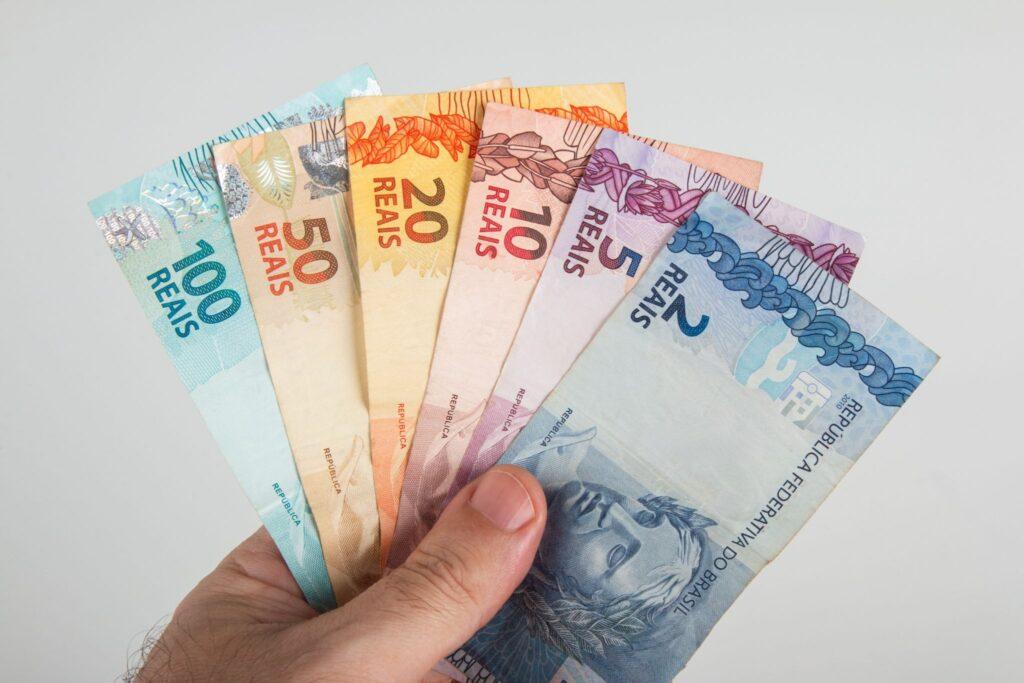
Current banknotes in Brazil include R$2, R$5, R$10, R$20, R$50, R$100 and R$200.
Current coins include 5, 10, 25 and 50 centavos, plus R$1.
The Central Bank of Brazil says the real is divided into 100 centavos, and these denominations make up the current cash system.
Brazilian banknotes are colourful and fairly easy to tell apart once you have seen a few.
Each note has its own main colour, the symbol R$, and a different value printed clearly on the front.
They also feature familiar Brazilian imagery, so they do not all blur into one when you are paying quickly.
The coins are also quite distinctive. They vary in size and colour, and the R$1 coin stands out for its bimetallic look, with a silver-coloured centre and a gold-toned outer ring.
Lower-value coins are smaller and simpler, so it is worth taking a moment to check them when you first get your change.
If you are handed notes and coins soon after landing, do a quick pause before you put them away.
Getting used to the look of each value makes handling Brazilian real cash much easier, especially in busy cafés, taxis, markets, and beach kiosks.
Is Brazil expensive for UK travellers?
It depends on where you go and how you travel.
Rio de Janeiro and other tourist hotspots can feel expensive, while quieter parts of the country may offer better everyday value.
The cost of a trip also depends on the season, the local market, and the strength of the British pound against the real at the time.
Like many large economies, Brazil has regional price differences. That is part of the broader story of the Brazilian economy.
The size of the country, the strength of its domestic market, and broader inflation trends all shape the travel experience and the exchange picture.
Hidden fees that catch travellers out when converting money
This is the bit that saves money.
Many people focus on the headline rate and forget the extras.
Hidden fees can show up in ATM use, overseas card spending, small print on transfer services, or poor airport exchange deals.
Before you buy, check:
- the actual exchange rates
- delivery or handling fees
- minimum order rules
- whether your bank adds extra charges
- whether the total transaction cost still makes sense
A good rate only matters if the total cost is still competitive.
Where to buy Brazilian reals in the UK
| Option | What to expect |
| Specialist bureau (online) | The simplest option for less common currencies: compare rates and order ahead. Get the best rates and swift home delivery with Manor FX. |
| High street banks | Some currencies may need ordering in advance; availability can vary by branch. |
| Post Office | Stocks a range of travel money, but less common currencies may be limited or unavailable. |
| Airport exchange | Convenient, but higher costs; stock of rarer currencies can be unpredictable. |
Buy your reals now

How to get your foreign currency with Manor FX
If you want to buy Brazilian real currency before you travel, Manor FX makes the process straightforward.
You can order Brazilian reais today online, check the exchange rate before you commit, and choose the option that suits your plans best.
Ordering in advance can be a smart move if you want your travel money sorted before you fly.
It gives you time to compare rates, plan your budget in GBP, and arrive in Brazil with some local cash ready for the first part of your trip.
Here’s how it works:
Choose your amount
Select Brazilian reais on the Manor FX website and enter how much you want to buy. You can work from your budget in pounds or choose the amount of Brazilian real you want for your trip.
Check the real time exchange rates
Before you place your order, you can review the exchange rate and see what you are getting for your money. This makes it easier to compare the overall deal and avoid rushed decisions later.
Pick delivery or collection
You can choose secure home delivery or arrange collection, depending on what works best for you. That gives you more flexibility if you want your foreign currency sorted before your departure date.
Review the details
Take a moment to check the total, your chosen amount, and any relevant charges or delivery details. It is always worth looking at the full cost, not just the headline rate.
Complete your order
Once everything looks right, you can place the order and wait for your Brazilian reais to be delivered or made ready for collection.
Travel with cash already in hand
Having some local money ready before you arrive can make the first few hours of your trip much easier, especially if you need to pay for transport, snacks, or small purchases straight away.
This can be a practical option if you like to get your currency sorted early, keep an eye on exchange rates, and travel knowing you already have some Brazil travel money ready to use.
And don’t forget, you can convert leftover Brazilian currency to pounds with Manor FX on your return. We offer excellent BRL to GBP exchange rates.
FAQs
What is the currency of Brazil?
The currency of Brazil is the real, and its currency code is BRL.
That code is mostly used in exchange-rate tools, currency converters, and travel money sites.
So while people in Brazil will usually talk about reais or show prices with the R$ symbol, BRL is the label you will often see when comparing rates from the UK.
In other words:
- real = the name
- reais = the plural
- BRL = the code
- R$ = the symbol
Once you know that, reading prices gets much easier.
Are BRL and R$ the same?
Yes, more or less. They both refer to the same currency, but they are used in different ways.
BRL is the official currency code, so you will usually see it on exchange tools, rate charts, and order pages.
R$ is the symbol used in Brazil itself. So if you see R$20 on a menu or a receipt, that simply means 20 Brazilian reais.
It is a bit like seeing GBP on a currency converter and £ in a shop window: same money, different format.